

ENT Credentials 101:
What “FACS” and “FAAO-HNS” Actually Mean
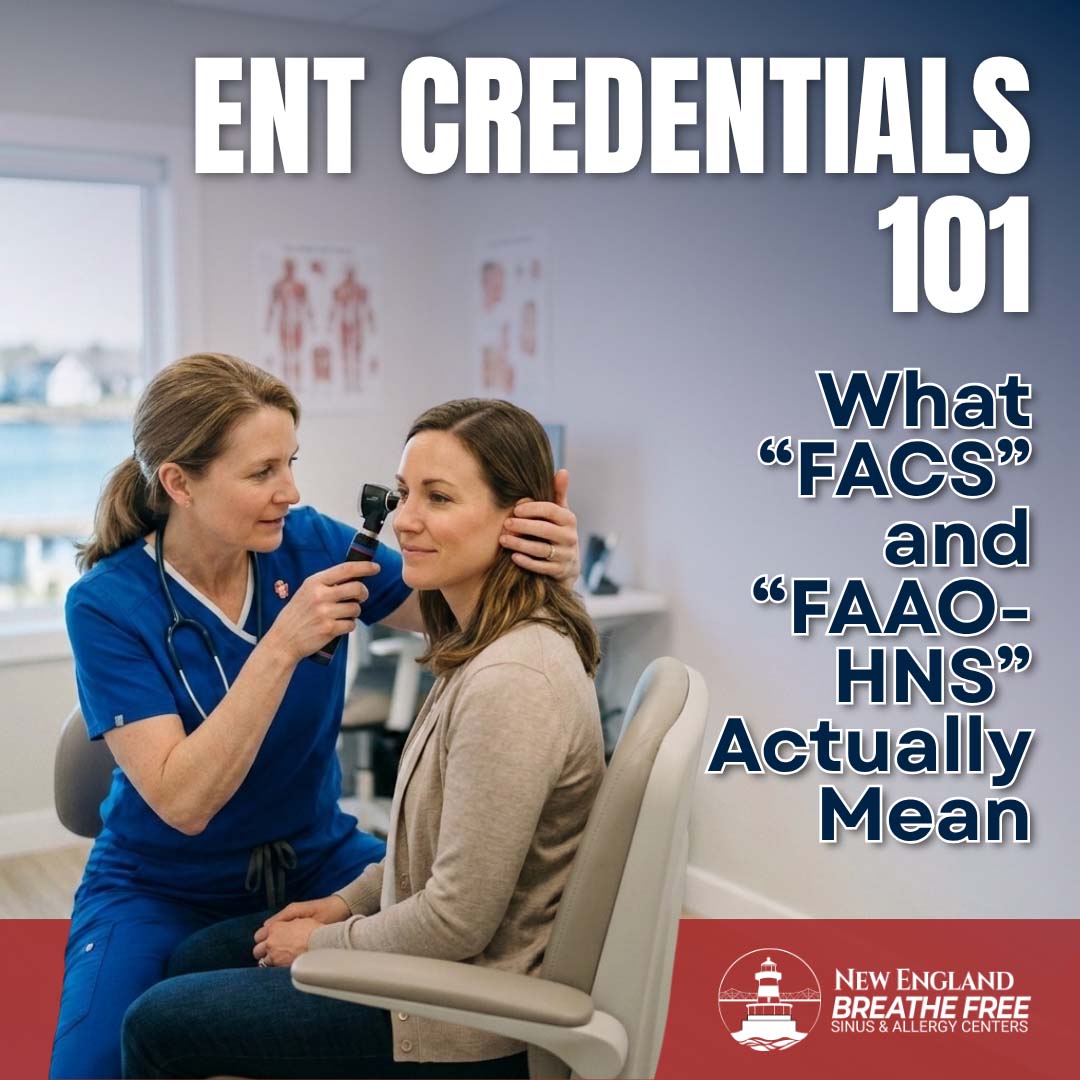
You’ve probably seen them — those strings of letters that follow a physician’s name on a clinic website, a business card, or a framed certificate on an exam room wall. FACS. FAAO-HNS. Board Certified. Fellowship Trained. They look impressive, but if you don’t know what they actually represent, they’re difficult to use as a meaningful filter when you’re trying to choose the right ENT for a chronic or complex sinus condition.
At New England Breathe Free Sinus & Allergy Centers, we think patients deserve to understand exactly what these credentials mean — not just that they exist. Here’s a plain-language breakdown of the designations that matter most.
What “FACS” Actually Means
FACS stands for Fellow of the American College of Surgeons. It is a peer-reviewed credential awarded to surgeons who have met a specific set of standards established by one of the most respected surgical organizations in the world. To earn the FACS designation, a surgeon must be board-certified in their specialty, demonstrate an ethical standing within their professional community, and be formally evaluated and accepted by the College’s credentials committee.
The designation signals more than technical training — it reflects a physician’s commitment to surgical ethics, continuing education, and professional accountability within a structured peer community. For patients evaluating an ENT surgeon, FACS indicates that the physician has been vetted not just by an examining board but by colleagues who have reviewed their standing in the profession. In New England’s competitive and highly educated healthcare market, it may be one factor patients consider when reviewing a surgeon’s background when surgical intervention — such as functional endoscopic sinus surgery or balloon sinuplasty — may be part of their care.
What “FAAO-HNS” Actually Means
FAAO-HNS stands for Fellow of the American Academy of Otolaryngology – Head and Neck Surgery. This is the specialty’s primary professional organization, and fellowship status within it carries specific meaning. It requires active board certification, demonstrated commitment to continuing medical education, and sustained professional engagement with the Academy’s standards and activities.
Where board certification confirms that a physician met the required standard at a defined point in time, the FAAO-HNS fellowship reflects ongoing participation in the specialty’s professional infrastructure. A physician carrying this designation is actively connected to the current research, updated clinical guidelines, and evolving treatment standards that the Academy produces and distributes. For patients in New England — where seasonal allergen complexity, older housing stock, and the region’s specific mold and pollen profiles require up-to-date clinical knowledge — that active engagement with current standards matters in a practical, not just symbolic, way.
How These Credentials Fit Into the Bigger Picture
Understanding individual credentials is useful, but it’s most useful when you know how they fit together. There are important things to consider before booking an appointment with an ENT, and credential literacy is one of the most underused tools patients have available to them.
Common credentials patients may see among ENT physicians include a medical degree, followed by a five-year accredited residency in otolaryngology, followed by board certification from the American Board of Otolaryngology – Head and Neck Surgery, followed by professional designations like FAAO-HNS and FACS that reflect ongoing commitment and peer recognition. For sinus and allergy specialists specifically, rhinology fellowship training sits on top of that stack — an additional one to two years of subspecialty focus on the nose and sinuses that goes well beyond what standard ENT residency covers.
No single credential tells the complete story. A physician can hold FACS and FAAO-HNS designations while practicing in a clinic without proper diagnostic tools. Credentials authorize care — they don’t guarantee the environment to deliver it. Modern ENT clinics that take sinus and allergy care seriously invest in nasal endoscopy, CT sinus imaging, comprehensive allergy testing, and in-office treatment options that allow credentials to translate into actual diagnostic and treatment precision.
Credentials Are a Starting Point, Not the Whole Answer
Knowing what FACS and FAAO-HNS mean gives you a more reliable lens for evaluating the physicians you’re considering. But choosing the right ENT requires combining that credential check with an honest look at the clinic’s diagnostic capabilities, subspecialty focus, and approach to patient communication.
At New England Breathe Free Sinus & Allergy Centers, our physicians hold relevant professional credentials — and practice within a clinical environment built to make those credentials count.
Are you ready to experience care from physicians with relevant training and professional credentials? Schedule your appointment with New England Breathe Free Sinus & Allergy Centers today!